NemosGo® DE
Infrastructure for payment, billing and delivery · EU-native

Buy and sell digital goods. Right where they are found.

From agreement to receipt, one transaction, cryptographically linked, for people and for AI agents.

On websites, in apps, on social media and in messengers, at the till and in AI assistants.

Finding has changed.
Buying has not.

Search
A search box with the query “Review of the premiere” and one hit below it: theatre review, two hours ago. Review of the premiere Theatre review two hours ago
Messenger
A message, “Did you see this?”, with an attached recording: video, 12 minutes. Did you see this? Recording Video, 12 minutes
AI assistant
An assistant answers “I found three sources on that” and lists three results. I found three sources on that.

Tech companies and card networks are working on solutions, the EU on new rules for payments. The problem has not been solved yet.

What NemosGo does

Today a purchase stalls at four points. Left behind are frustrated prospects who do not want to go through entering their details, and who buy nothing. With NemosGo the purchase is one transaction.

How it works today

Find the productwhere the customer finds it
Shopswitch sites, create an account
Purchasefill in the card form
Billingseparately, afterwards
Deliveryby email, later
Receiptby yet another route
Product in handif the purchase goes through

What was bought arrives by a separate route.

How it works with NemosGo

Find the productwhere the customer finds it
Agreementprice and terms
Paymentfrom 0.01 cent
Billingpurchase and service matched
Deliveryin the same transaction
Receiptfor both sides
Product in handimmediately

One transaction, one receipt, no switching between systems.

People buy where they find things. A wallet with credit is all it takes.

Watch NemosGo in 2 minutes →

Products

Sell and bill

You sell item by item or bill by actual usage, from a single article to a single request from a machine. It all stays one transaction, with a receipt for both sides.

Buy and allocate costs

You approve an amount, a purpose and a period, and your agent buys within it. Every transaction is paid for and documented, and the costs are attributed without anyone consolidating statements.

Run auctions

For anything whose price is not fixed in advance: remaining tickets, scarce goods, the empty seat on Friday evening. You set the starting price and the rules, and in the app the price rises or falls. Whoever takes it or wins the bid pays at once and has the goods and the receipt.

For sellers and for buyers

Sell where your customers are. Buy yourself, or let agents buy within limits you set.

On the left the offering with content, data and services, in the middle NemosGo with selling, buying and auctions, on the right the customers, people and machines. Between them five channels: web, in-store till, social media, messenger and AI assistant. At the customer it reads paid, delivered, documented. Offering Content · data · services Web In-store till Social media Messenger AI assistant NemosGo Sell and bill · buy and allocate costs · auctioning Customers people and machines paid delivered documented The money goes to the provider The provider pays the fee at top-up or collection, not on every purchase The same in portrait: the offering at the top, below it the five channels, then NemosGo, and the customers at the bottom. Offering Content · data · services Web In-store till Social media Messenger AI assistant NemosGo Sell and bill Buy and allocate costs Auctioning Customers people and machines paid delivered documented The money goes to the provider The provider pays the fee at top-up or collection, not on every purchase

If you sell

  • All digital goods and services. Text, images and video, music and audio, data and lookups, software and model calls, tickets, computing time.
  • All channels. Website, app, social media, messenger, in-store till, AI assistant.
  • The smallest amounts, continuously. From 0.01 cent, a hundredth of a cent, paid for and documented one by one, call by call.
  • Cheaper on the payment side. Private customers top up once, business customers can optionally pay for many purchases together afterwards. The fee is charged there, not on every purchase.
  • Under your brand, into your account. What your customers top up or you collect sits in your account, in euros. Your buyer has a contract with you, not with NemosGo.
  • One fee for the software. If you use NemosGo yourself. NemosGo takes no share of the sale price.

For sellers →

If you buy

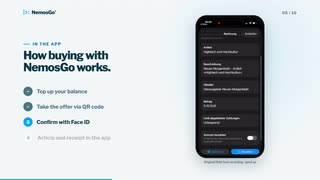
  • Buy yourself. In the app, privately or at work, with no customer account in the shop and no card form. You confirm each purchase yourself.
  • Let an agent buy for you. If you send an AI assistant or an application off with a task, you approve an amount beforehand. It then buys within that amount without asking each time.
  • No blank cheque. Today an agent buys with a password and a card number, that is, with full authority. Here only up to the approved budget.
  • A receipt per call. Every purchase is paid for and documented, and in a company attributed to an application, a team or a client.
  • Pseudonymous. The seller gets your name only if you choose to share it.
  • Buying costs nothing extra. If you use NemosGo to allocate costs in your company, you pay a fee for the software.

For companies that buy →For individuals →

See the technical flow →

Our principles

EU-native
Developed in Europe, hosted under European jurisdiction.
Data-minimal
Every transaction uses only the data it needs. The seller gets the buyer’s name only if the buyer chooses to share it.
Under control
Purpose, price and limits are agreed beforehand.
Documented end to end
Every step is cryptographically linked to the others and can be checked.
Secured from the ground up
Encrypted transport, access controlled and logged, a small attack surface. Every payment is tied to its delivery.

Together this makes a payment method that is low-cost, fast, accessible and traceable: the four yardsticks the G20 roadmap applies to payments.

Who we build for

We build for two sides: for providers who sell digital goods, one at a time, by usage or at auction, and for companies whose agents buy. The industries below stand mainly for the selling side. Any company can let its agents buy.