
When NemosGo is worth considering
- Renewing the checkout or opening it to more channels, while your shop or ticketing system stays where it is
- Selling single items instead of only subscriptions, including to people who will not sign up for anything
- Selling amounts below one euro, without the fixed fee per card payment eating the proceeds
- Opening offerings to AI agents, alongside your existing interface
- Selling with less dependence on platforms, under your brand and with the money in your account
Examples
- 18 newspaper articles, €4.50
- Four stock images, €2.00
- Video recording, €25.00
- 2 commercial register extracts, €1.00
- Weather data for a machine, €0.00
- 2,327 ms of compute, €0.0047
- Consent in an application process, €0.00
Even at €0.00 there is a transaction with a receipt, for recording a consent, for example.
Which industries we have in mind
Where you sell
Your offer sits where your customers already are. What differs is only how the buyer gets to it.
- Website and app. The offer sits on your page, and the buyer follows a link or a QR code.
- Social media. The offer sits in a post, live in a stream as well, and the buyer follows a link or a QR code.
- Messenger and AI assistant. The offer sits in the middle of the conversation, and the purchase is triggered there.
- Till in the shop, planned. Your point-of-sale system shows the amount as a QR code, and the buyer scans it and confirms in the app. The app then shows a payment code, which the till scans.
Who buys
People and machines buy through the same checkout, which sits between your offering and the buyer.
The only difference is when consent is given. If a person buys themselves, even when an assistant shows them the offer, they confirm each purchase in the app. If they send an assistant or agent off with a task, they approve an amount for it beforehand, with a purpose, a period and a maximum per call. Within that the agent buys without asking, privately and at work alike.
How a company gives its agent that approval is covered under Buy and allocate costs.
How payment works
Every purchase runs through the same five steps: agreement, payment, billing, delivery, receipt. Payment takes one of three forms.
Two examples
The single purchase
Payment and goods are one act. The buyer needs no account with the seller.
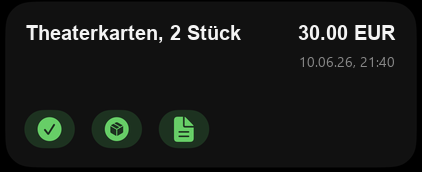
An example: two tickets for 30 euros in total.
- AgreementTwo tickets, €15.00 each.
- PaymentFrom their credit, confirmed in the app.
- BillingPurchase and service matched.
- DeliveryTwo tickets as PDF, plus a behind-the-scenes video.
- ReceiptIn the buyer’s app, with its own number.
I would like to go to the theatre tonight.
The big theatres are still on their summer break. Tonight Antigone is playing in the courtyard of the Glyptothek, 8 pm.
And the city theatre?
The season starts on 24 September. Die Geierwally is on the 25th and the 27th.
Book me two tickets for the 25th.
Two seats are in the basket, stalls row 9, 30 euros in total. The ticket shop now asks you to sign in. Passwords, account creation and payment details are not something I do.
With NemosGo
Shall I buy the tickets?
Yes.
Waiting for confirmation. Payment happens in the NemosGo app, the chat debits nothing.
Paid and delivered. The tickets are in the wallet, the date is in the calendar.
The purchase happens where the conversation happens, with no customer account in your ticket shop. Recording of a ticket purchase, unedited
Usage-based
The same transaction repeats for as long as usage continues. The price per unit or the rule is set beforehand, the amount follows from actual consumption.
An example: you offer an AI model through an interface and charge for computing time, 0.2 cents per second. An answer that takes 2,327 milliseconds to compute costs €0.0047. Your customer’s application pays for every call from its credit, in the same step in which it fetches the answer. For each call you see the amount, a pseudonym and the receipt. When usage stops, billing stops, with nothing to cancel.
Recording: buying model usage, unedited
Less to steal
Your shop and your interface see only a pseudonym, the amount and the receipt per purchase. No customer accounts, card numbers or passwords end up there, and you get a buyer’s name only with their consent. What payment requires sits separately in the NemosGo installation, and the rest of your system stays free of it.
What you decide
You decide three things yourself:
- Price and unit. A fixed price per item or per call, or a price per unit consumed, for example per 1,000 tokens or per second of computing time.
- Minimum and cap. Optionally, a price can have a minimum or a cap.
- Cancelling. If you mark an offering as cancellable, you allow refunds: the buyer files the request in their purchase history, you decide, and on approval the buyer gets the amount back and the goods disappear from their app. You void them in your own system.
What it costs
If you use NemosGo yourself, you pay a monthly software fee, tiered by usage. NemosGo takes no share of the sale price.
The payment fee is charged once at top-up or collection, for many purchases. With card payments it is charged on every single purchase. What setup and operation cost, if you hand both over to us, is described under For sellers.
In practice
From July to August 2026 the complete transaction ran at three organisations: a culture magazine, an event organiser and a charitable organisation. Purchases were made on the website, in a messenger and by QR code, and from the end of July in an AI assistant as well. At the culture magazine alone, more than 500 purchases have been made since June.
Payment was made with test credit. Within the system it was real credit; it was simply issued to participants rather than paid in from a bank account. Payment, delivery and receipt ran exactly as they do with euros. The only thing still open is connecting the bank account for paying in and out through the licensed payment service provider. It changes nothing about the purchase itself.
What you need for it is described under For sellers. The full sequence is on the technology page, the integration on the developer page.
If you want to know what the transaction would look like at your end, write to us.